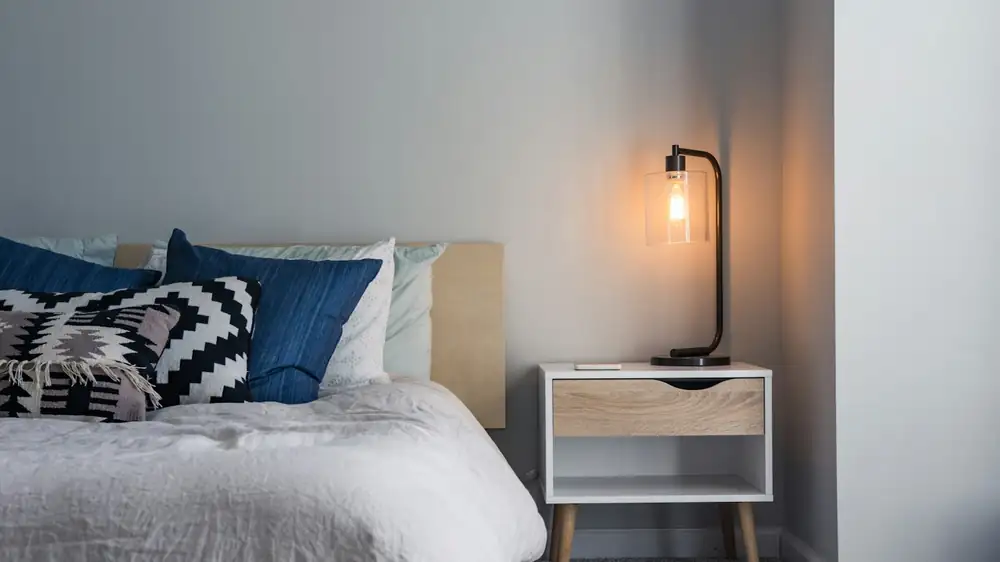
A standard double bed occupies 1.4 × 1.9 metres of floor. Underneath that is 2.66 m² — larger than most bathroom floors — and in a small bedroom it is the biggest single opportunity available.
It is also the most commonly wasted, for one reason: people fill it in a way that makes it inaccessible, and then never touch it again.
This article covers the actual capacity of each bed type, four storage methods ranked by usefulness, and the specific failure modes that make under-bed storage useless within three months.
Measure the gap first
Before buying anything, measure the clearance from floor to the underside of the bed frame.
Do it in the middle of the bed, not at the corner. Bed frames sag, and the middle is always lower. A frame with 25 cm at the corner often has 20 cm in the middle.
| Gap height | What fits | Notes |
|---|---|---|
| Under 12 cm | Nothing useful | Flat bags only, and they will not slide |
| 12–18 cm | Shallow boxes, flat bags | Best for documents, thin items |
| 18–25 cm | Standard under-bed boxes | The sweet spot |
| 25–35 cm | Deep boxes, drawers, small baskets | Good capacity, harder to lift |
| Over 35 cm | Almost anything, including drawers | Rare in standard frames |
Also check whether the bed has legs or a solid base. A divan base has no gap at all. A frame on legs has the gap plus the volume between the slats, which you cannot use.

The four methods, ranked
1. Lidded boxes on castors — best overall
What it is: a plastic or fabric box, typically 60 × 80 × 18 cm, with a lid and four small wheels.
Capacity: roughly 36 litres each. Four fit under a double bed, giving about 145 litres.
Why it wins: the castors are the whole point. A loaded box without wheels weighs 8–12 kg and cannot be pulled across carpet. With castors, it slides out with one hand.
Cost: $15–25 each.
What to look for:
| Feature | Why it matters |
|---|---|
| Castors on all four corners | Non-negotiable |
| A visible pull handle on the long side | If you cannot see the handle, you will not pull |
| Height within 2 cm of the gap | More and it will not slide |
| Lidded and rigid | Rigid sides stop contents collapsing inward |
| Transparent or labelled end | You need to know what is inside without opening it |
Placement rule: at the edges of the bed, never the middle. Boxes in the middle get pushed back during cleaning and never retrieved. This is the single most common reason under-bed storage fails.
Content rule: things you need twice a year. Off-season clothing, spare bedding, luggage, seasonal shoes. If you are opening the box monthly, the content belongs somewhere else and the box will become an obstacle.
2. Pull-out drawer frames — best if you can fit one
What it is: a shallow drawer on runners, mounted on a frame that sits under the bed, usually with two drawers side by side.
Capacity: two drawers of 70 × 55 × 15 cm give roughly 115 litres, but with full-length access and no lifting.
Why it is good: you never lift anything. The drawer comes out horizontally, contents visible, and goes back in one motion. That one-motion access is what keeps a system alive.
Cost: $60–150.
Why it is not first: it needs the bed frame to be tall enough (at least 20 cm clearance), it does not fit divan bases, and it is bed-specific — if you move, it may not fit the next bed.
The check before buying: measure the internal distance between the bed legs, not the external width. Many drawer frames are listed by external size and do not fit between the legs.
3. Vacuum bags — mostly a trap
What they promise: compress a winter duvet to 3 cm and store it in almost nothing.
What actually happens:
- They compress well once, then the seal fails at the seam or the zip
- They compress into an irregular shape that does not stack
- They hide the contents, so you buy duplicates
- They can damage natural fibres if stored compressed for a long time
Where they are acceptable: storing a single large item you genuinely do not need for a year, in a place where the bag will not be moved. Under a bed, where boxes get pushed and pulled, they fail.
Verdict: use them only as a last resort, and never for anything you will need within six months.
4. Open baskets — acceptable for one specific use
What it is: a shallow basket, no lid, slid under the bed.
Capacity: 20–30 litres, but only really usable for the front 30 cm nearest the edge.
Where it works: as a "daily access" zone for slippers, a book, or the clothes you take off before bed. It is the under-bed equivalent of a bedside table.
Where it fails: for anything bulk. Open baskets let dust in, and in a carpeted room the contents get furry within weeks.

The four failure modes
Understanding why under-bed storage is abandoned helps you avoid it.
Failure one: boxes in the middle
The most common. Boxes get pushed toward the middle during vacuuming and never come back out. Fix: put them at the edges, and leave the middle empty.
Failure two: no handles
A box with no visible handle, under a bed, in a dark space, will not be pulled out. Fix: choose boxes with a moulded pull handle, or tape a fabric loop to the visible end.
Failure three: too heavy to move
A box filled with books, tins, or tools weighs too much to pull without castors. Fix: castors, or restrict contents to textiles.
Failure four: contents forgotten
If you cannot see or remember what is inside, you will buy duplicates — which defeats the purpose entirely. Fix: label the visible short end with a marker, or use transparent boxes for the most-used category.
What to store under the bed
The right answer depends on frequency, but here is the category guide:
| Item | Suitable? | Why |
|---|---|---|
| Off-season clothing | Yes | Accessed twice a year |
| Spare bedding and linen | Yes | Perfect — flat, light, seasonal |
| Winter coats | Yes | Bulky and seasonal |
| Suitcases | Yes | They store other things inside them |
| Shoes (off-season) | Yes | If boxed, to keep them clean |
| Books | No | Too heavy without castors |
| Documents | Yes, if flat and dry | Keep off a cold floor in humid climates |
| Anything food-related | No | Moisture, pests |
| Electronics and cables | No | Static, moisture, and you will forget them |
| Anything you use monthly | No | It belongs somewhere accessible |
The capacity comparison
For a standard 140 × 190 cm bed with 22 cm of clearance:
| Method | Volume | Access | Cost |
|---|---|---|---|
| 4 lidded boxes on castors | 145 L | Good (pull out) | $60–100 |
| 2 pull-out drawers | 115 L | Excellent | $120–150 |
| Vacuum bags | 60 L effective | Poor | $25 |
| Open baskets | 40 L effective | Good for front only | $20 |
| Doing nothing | 0 L | — | — |
The gap between doing nothing and four boxes is the entire opportunity, and it costs about $80.
The checklist
Before you buy:
- [ ] Measured clearance in the middle of the bed, not the corner
- [ ] Checked whether the frame has legs or a solid base
- [ ] Measured the internal width between legs (for drawer frames)
- [ ] Decided which category goes underneath (should be seasonal only)
- [ ] Confirmed boxes have castors and a visible handle
After you install:
- [ ] Boxes at the edges, middle left clear
- [ ] Contents labelled on the visible end
- [ ] Nothing under the bed that is needed monthly
- [ ] A quick check at three months: can you still pull every box out?
If the answer to that last question is no, the system has failed and the fix is almost always repositioning rather than buying something new.
The honest limit
Under-bed storage works best for flat, light, seasonal things. It fails for heavy, irregular, or frequently-needed items.
If your bedroom has no wardrobe and you are trying to store all your clothing under the bed, that is not a storage solution — it is a sign that the clothing volume exceeds the room, and the real answer is rotation and reduction, not more boxes.
Use under-bed space for what it is good at, and solve the rest of the problem elsewhere. Trying to make it do everything is how it ends up empty and forgotten.